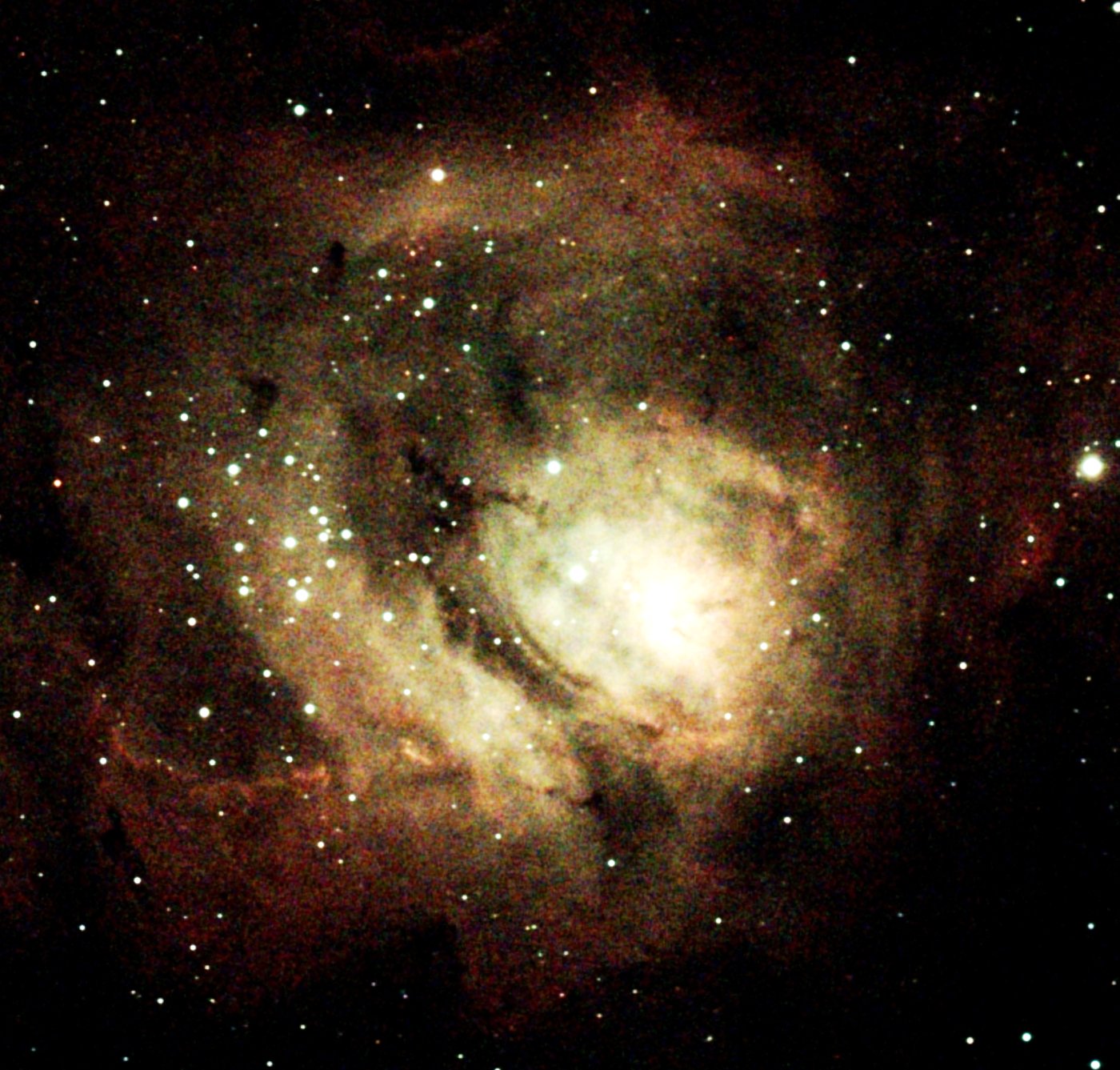
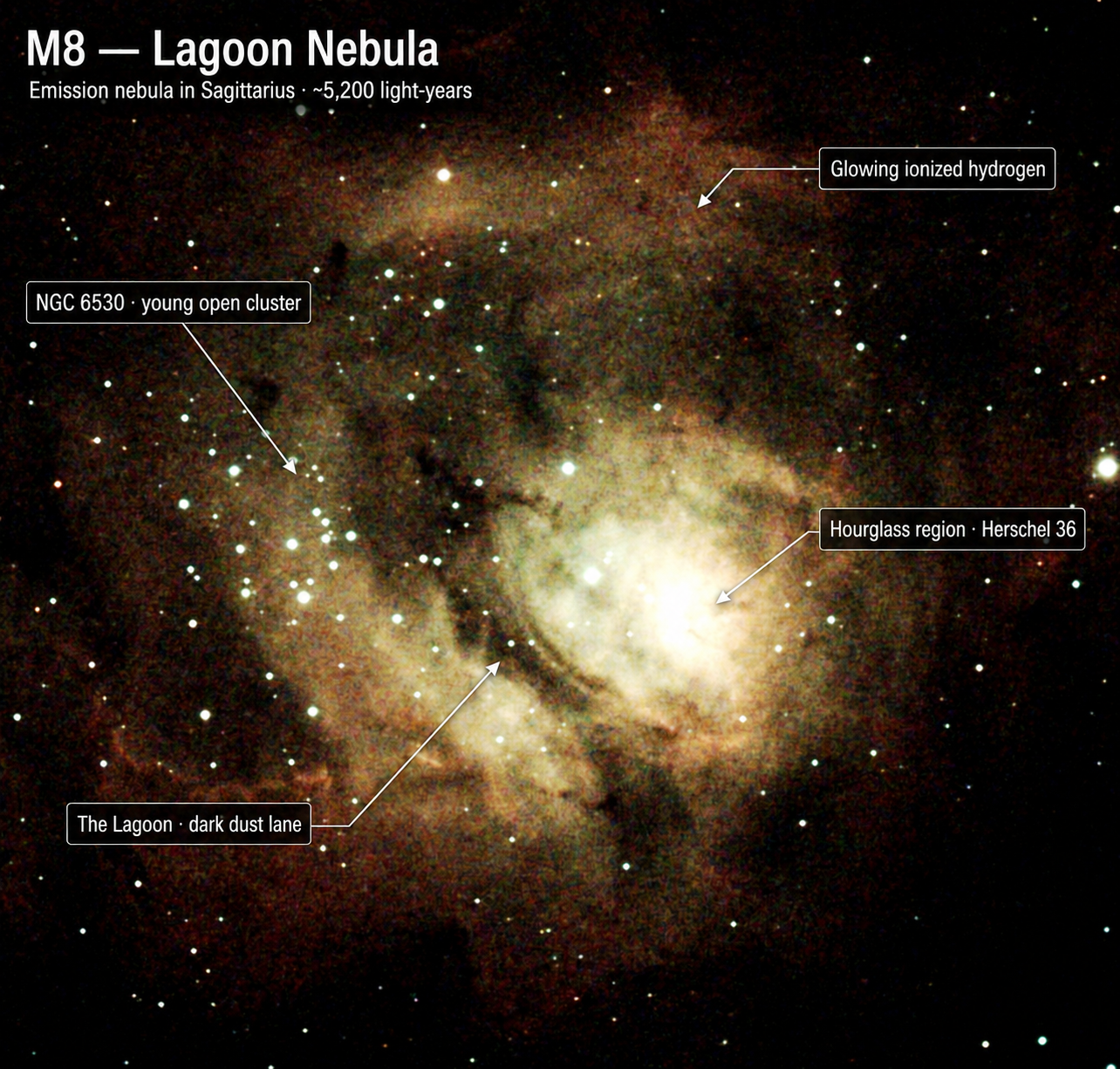
Picture 1 — M8 — Lagoon Nebula Messier 8 (M8), commonly called the Lagoon Nebula, is a vast stellar nursery located about 4,100 light-years away in the constellation Sagittarius. Spanning roughly 100 light-years, it is an emission nebula: ultraviolet radiation from young, massive stars ionizes the surrounding hydrogen gas, causing it to glow. The dark “lagoon” crossing its center is a dense lane of interstellar dust that blocks visible light from the luminous gas behind it. Embedded within the nebula is NGC 6530, a young open cluster whose stars formed from the same enormous cloud of gas and dust.
Star formation remains active throughout M8. Dense knots known as Bok globules may eventually collapse to produce additional stars, while radiation and stellar winds from existing hot stars sculpt the surrounding material into ridges and cavities. One especially bright region, the Hourglass Nebula, is energized largely by the massive young star Herschel 36. M8 therefore provides astronomers with a nearby laboratory for studying how stars form—and how newly formed stars reshape the cloud from which they emerged.