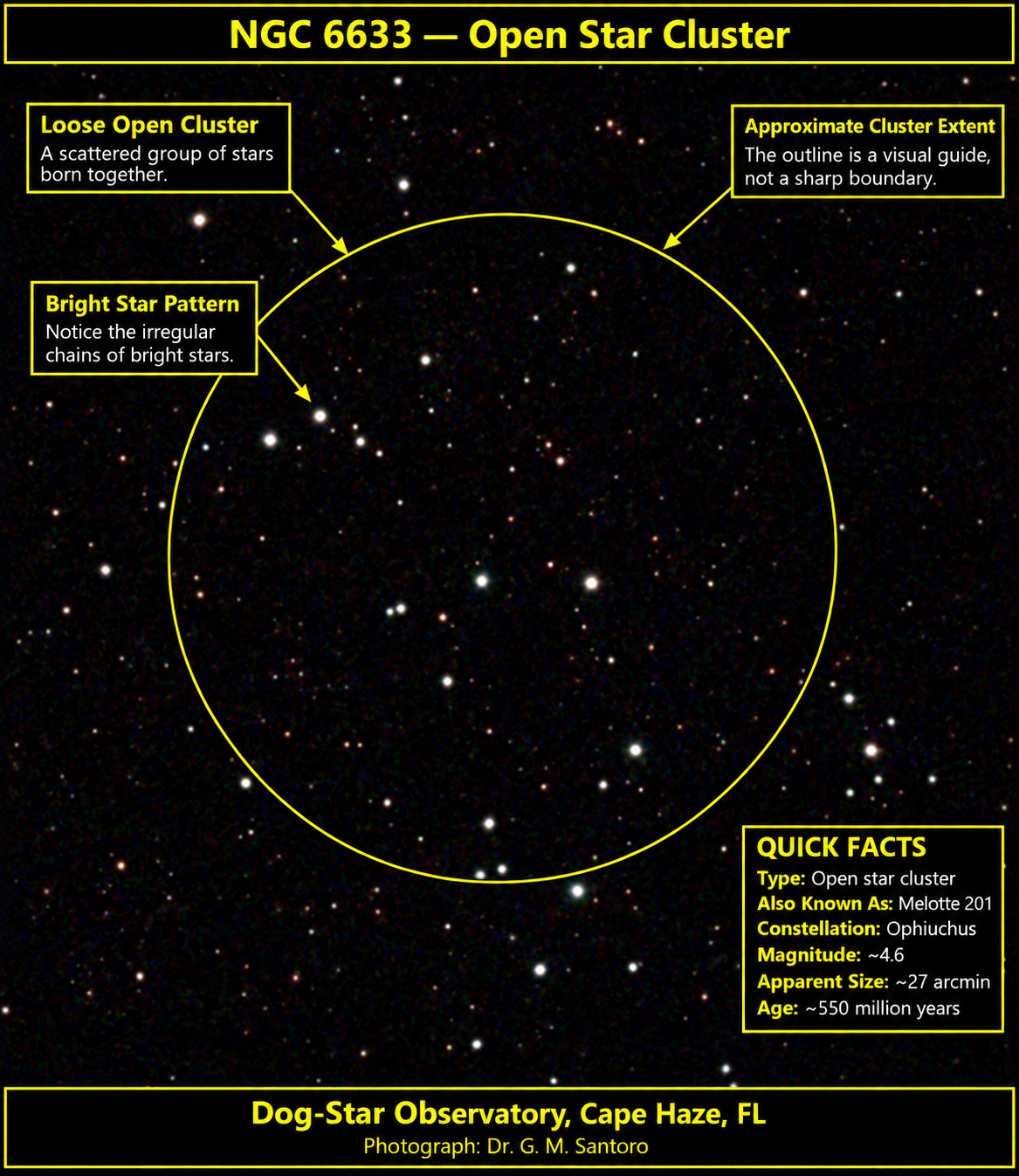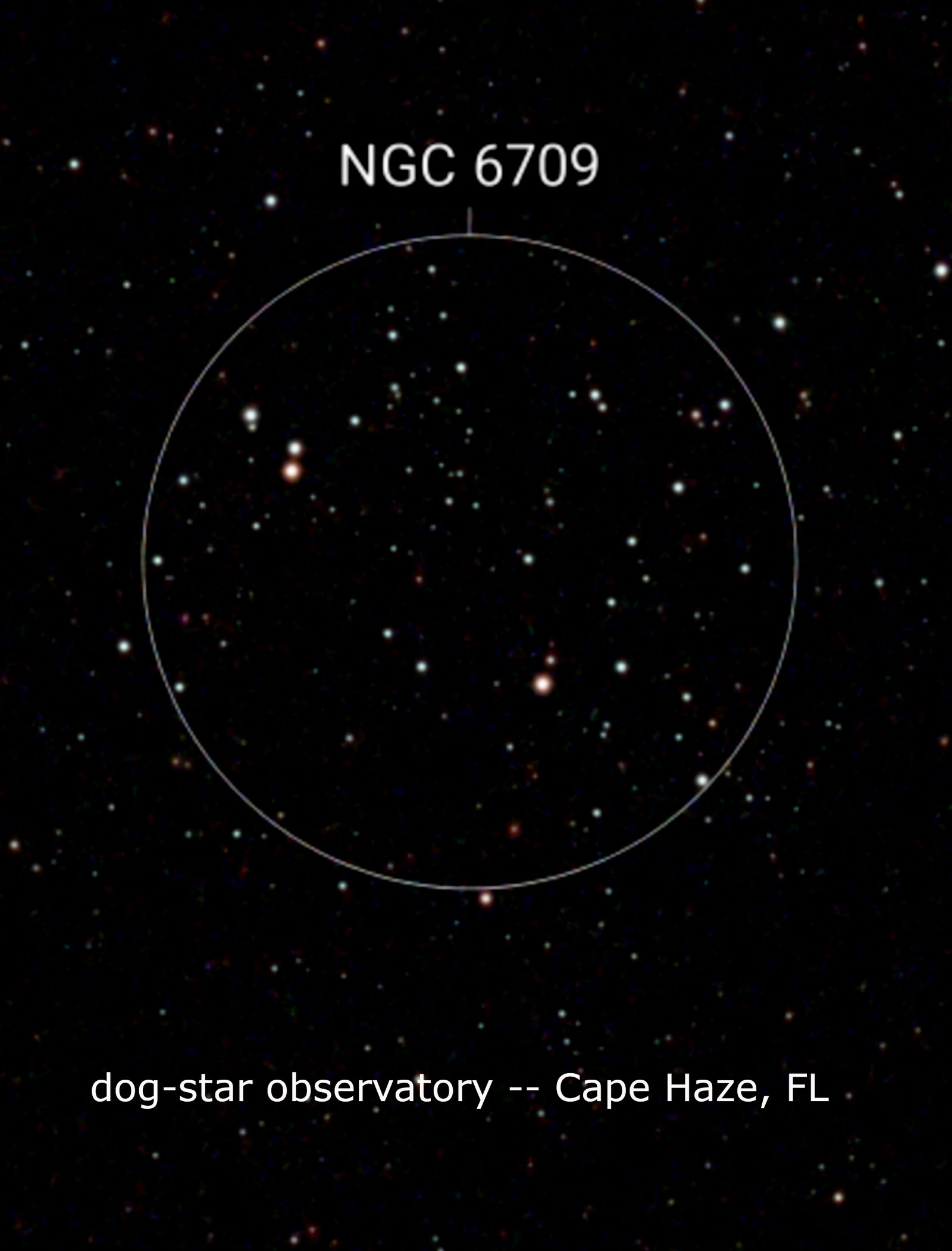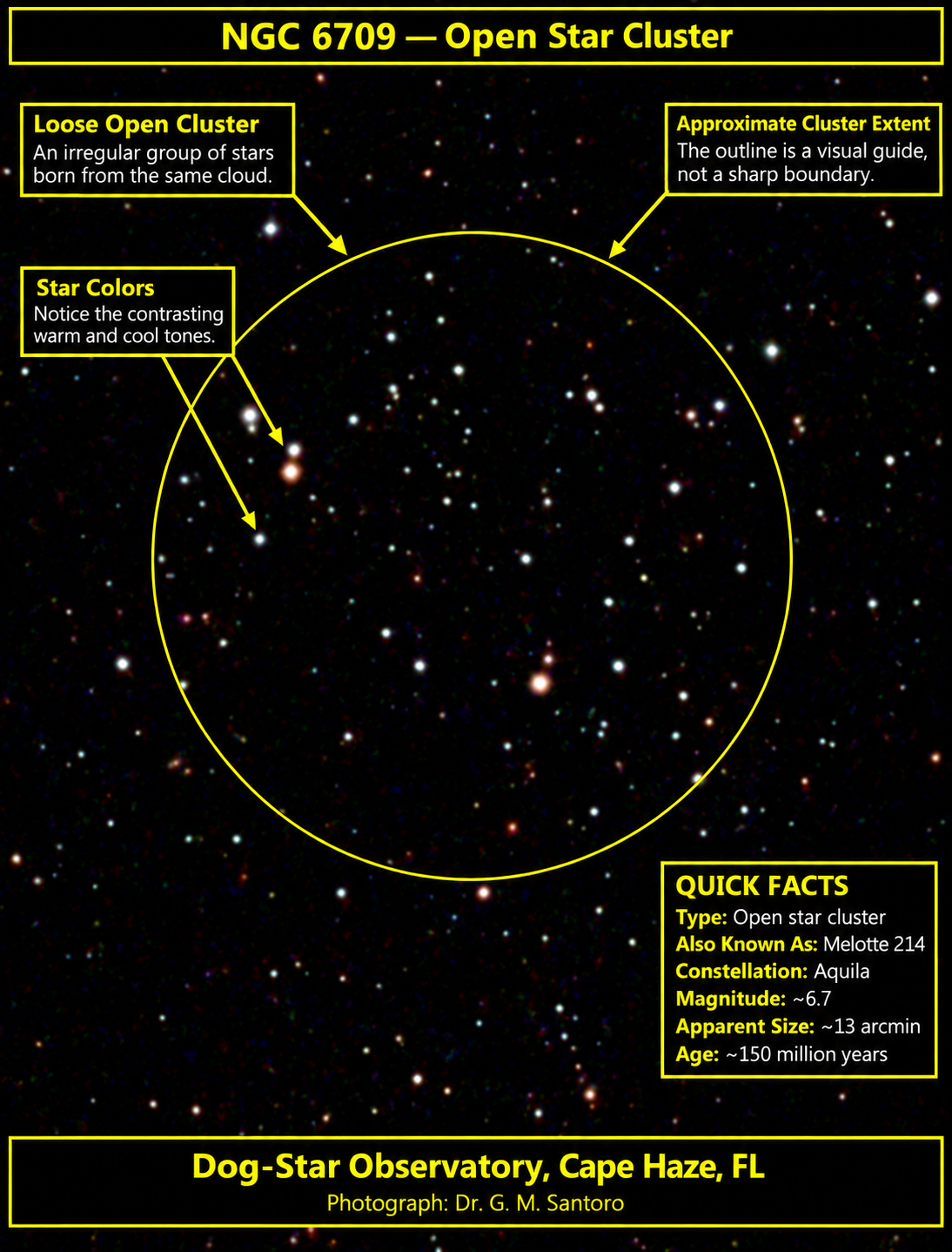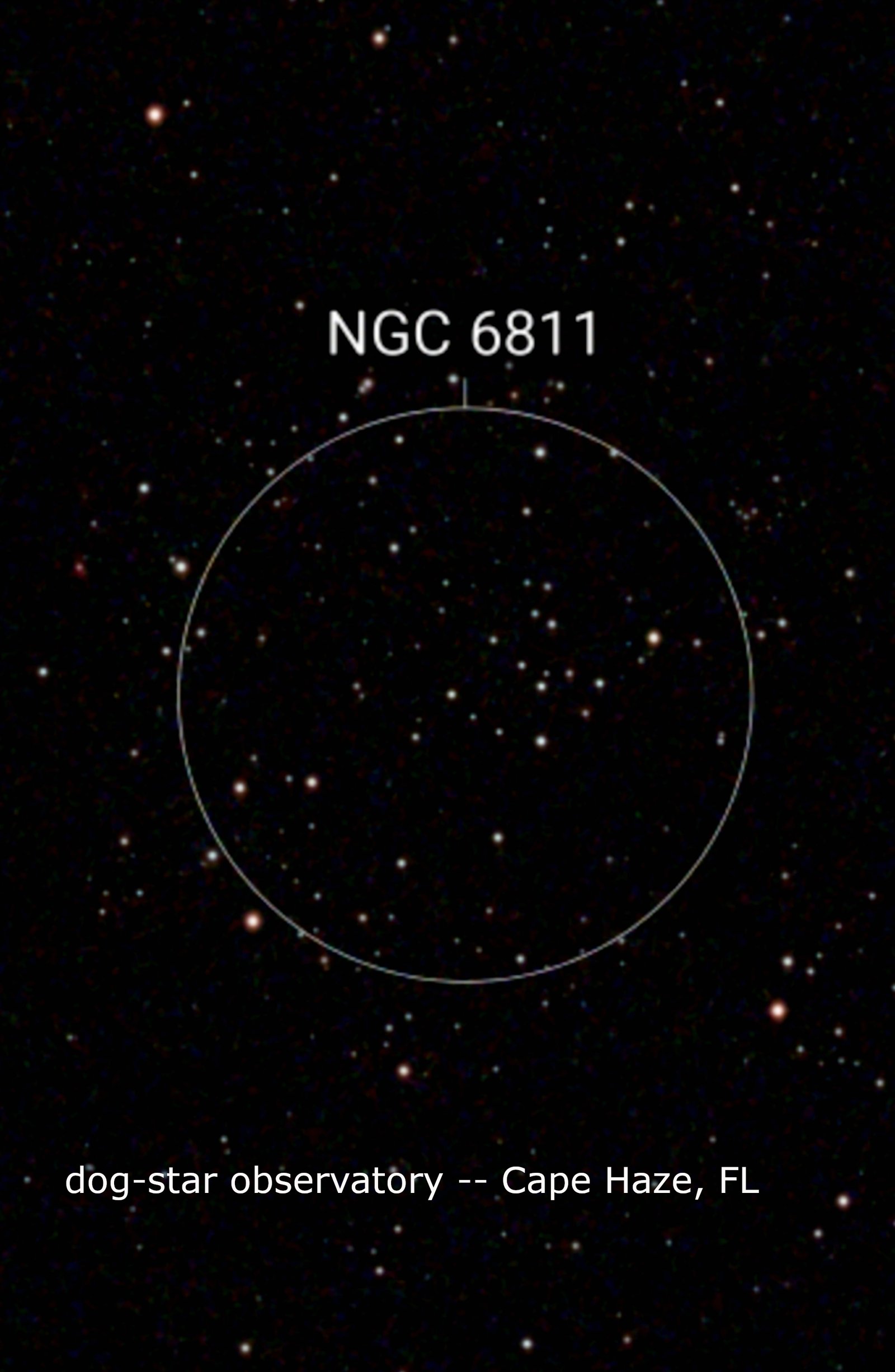
Open clusters are clusters of stars that have formed from the same enormous gas and dust cloud. They are often associated with the nebula from which They formed. given a few million years the stars that formed, of all different sizes, evolve and the brighter ones blow away the remaining gas and dust.
Given a few million more years the cluster stars move apart and the cluster can no longer be recognized without calculating the motion of each of the stars.
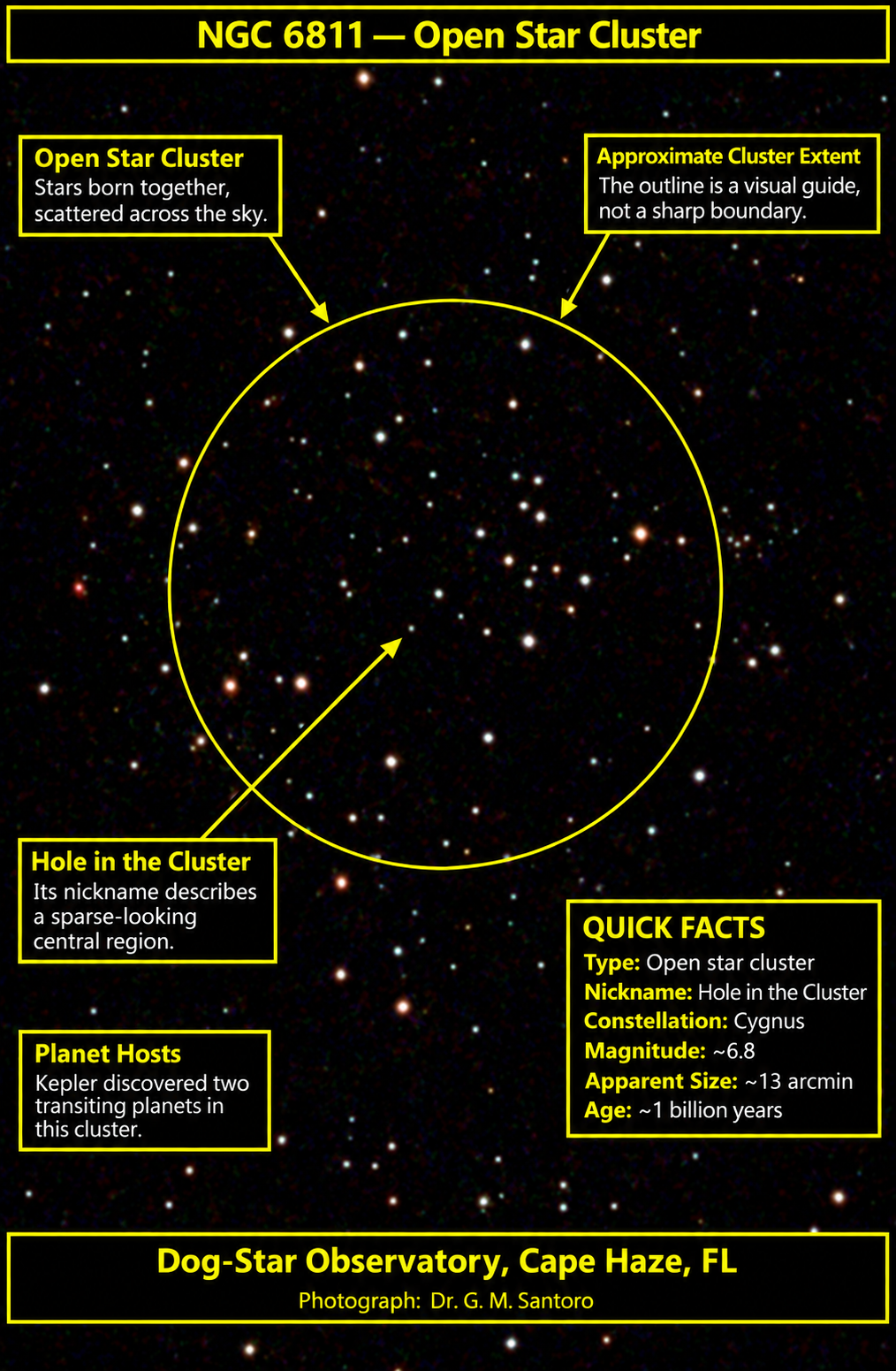
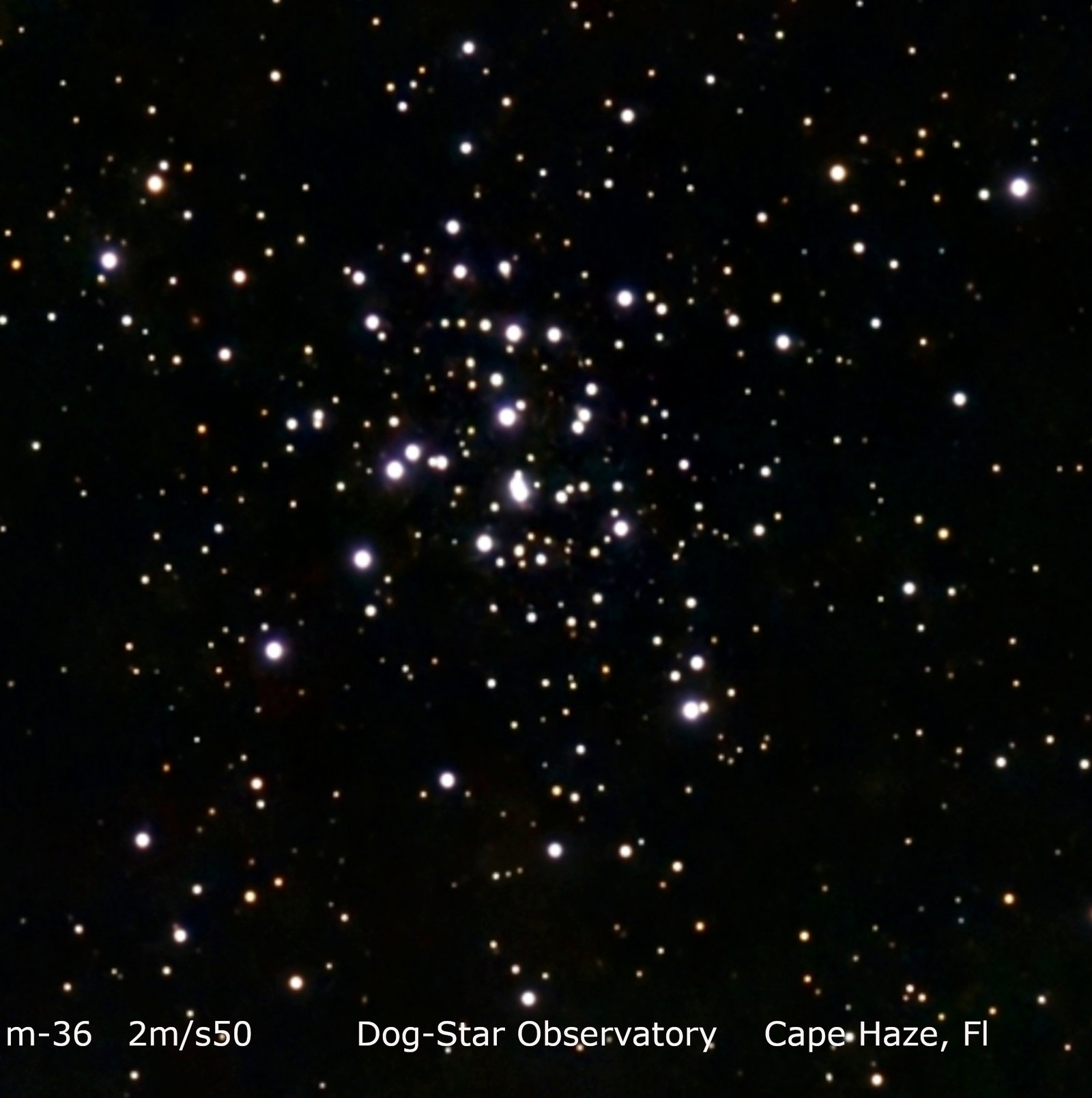
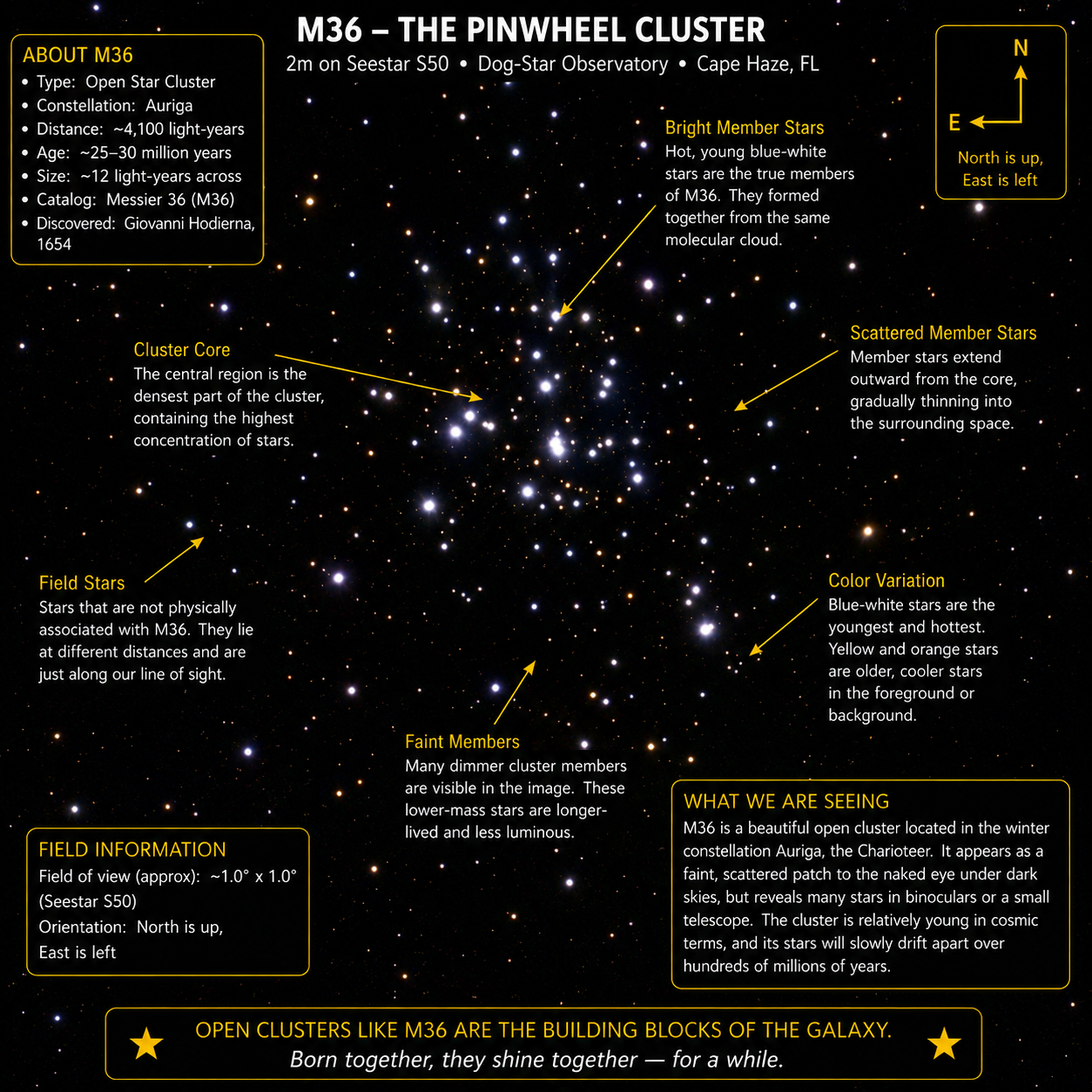
Each pair shows the original photograph on the left and the annotated version on the right. Annotations generated by GPT; photographs by Dog-Star Observatory, Cape Haze, FL. Click either photograph to open its larger version.
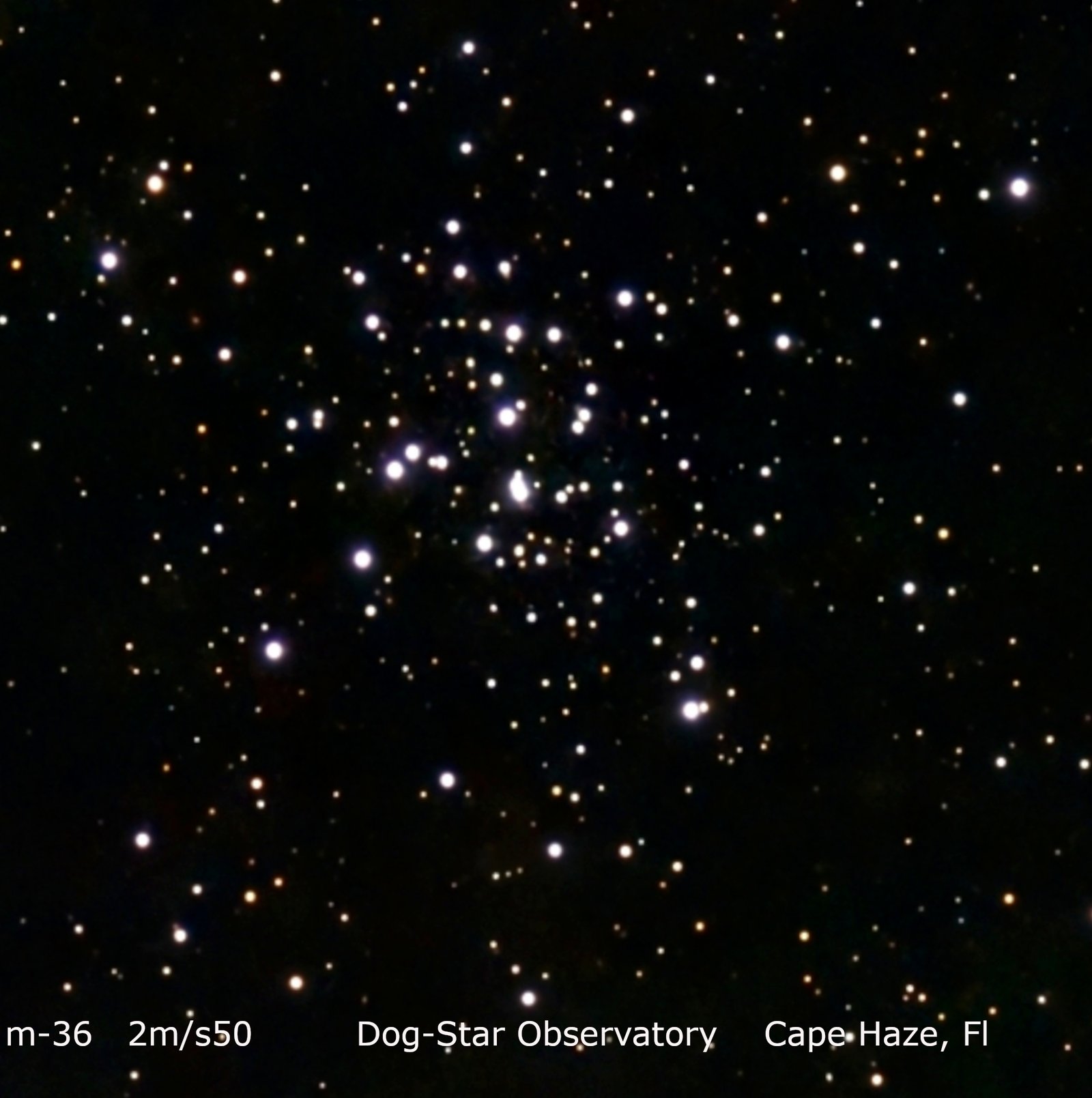
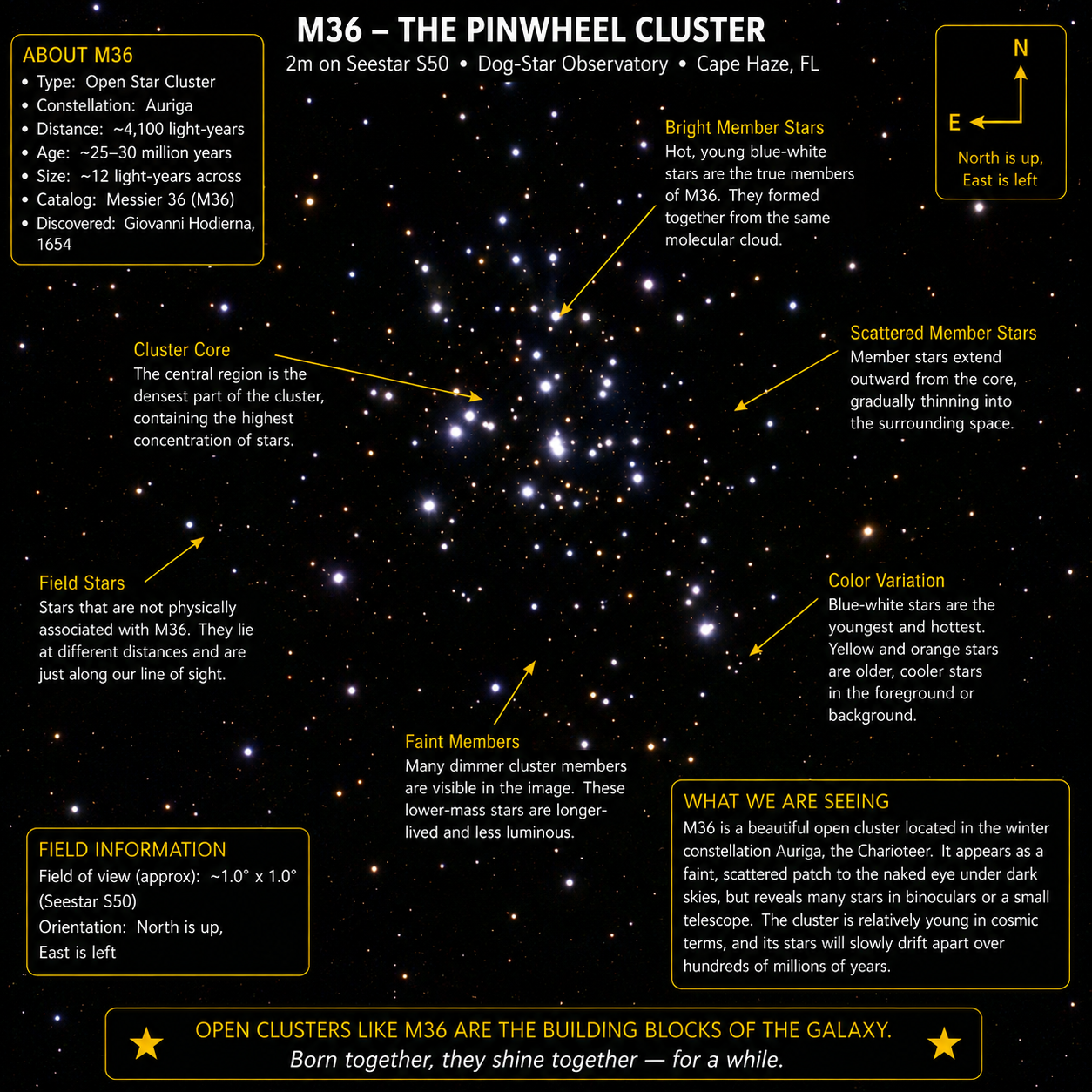
Messier 36 is a young open star cluster in the constellation Auriga, located roughly 4,000 light-years from Earth. It contains several dozen easily visible members and many fainter stars, all of which formed from the same molecular cloud only about 25–30 million years ago. The brightest members are hot, blue-white stars that are considerably more massive and luminous than the Sun. Because open clusters are only loosely bound by gravity, M36 has a much more scattered appearance than a dense globular cluster.
M36 is especially useful for studying early stellar evolution because its stars share approximately the same age, distance, and original chemical composition. The different brightnesses and colors seen within the cluster primarily reflect differences in stellar mass. Over time, gravitational encounters among the stars and tidal forces from the Milky Way will gradually disperse the cluster into the surrounding Galactic disk. In that sense, M36 provides a snapshot of a young stellar family before its members eventually drift apart.
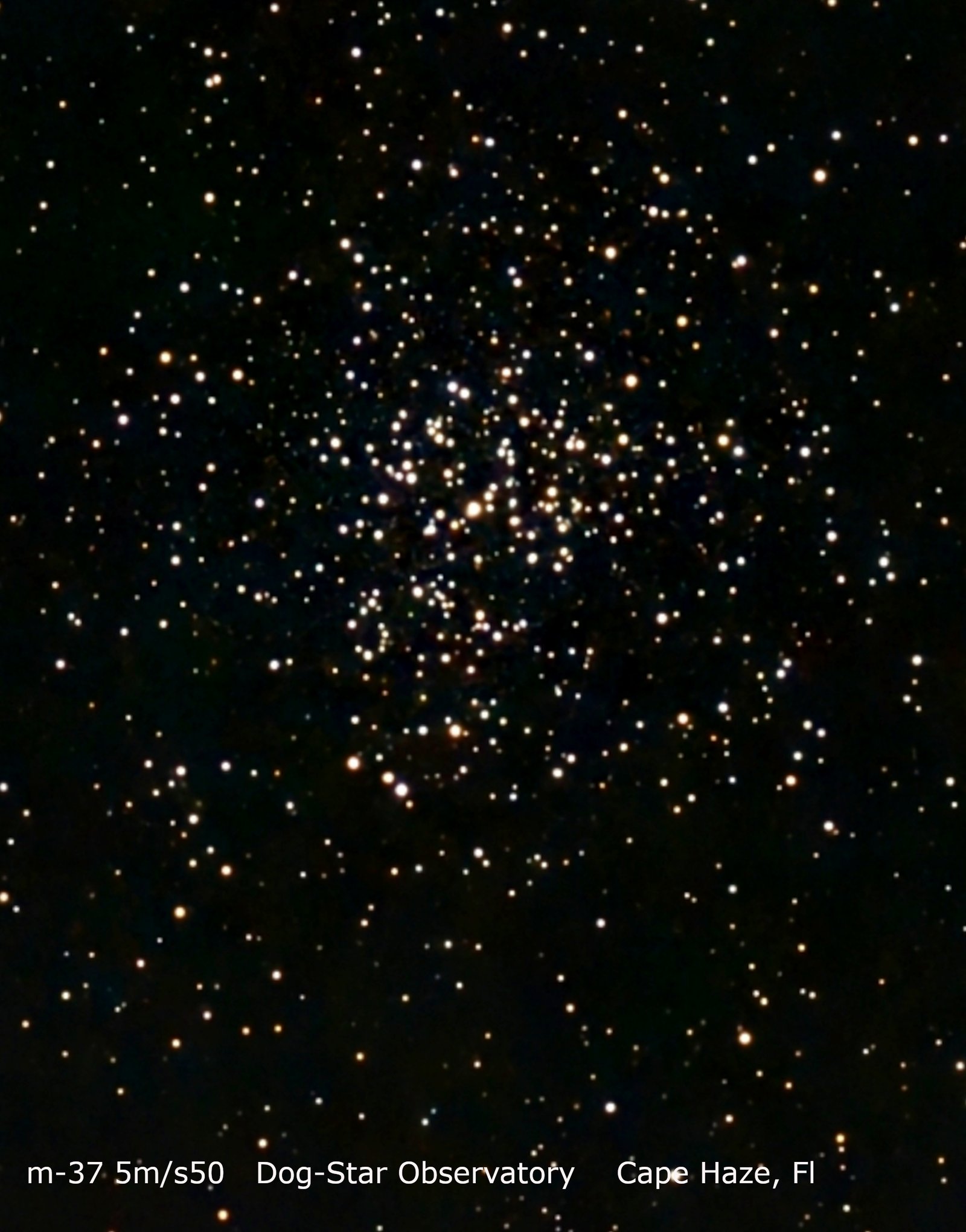
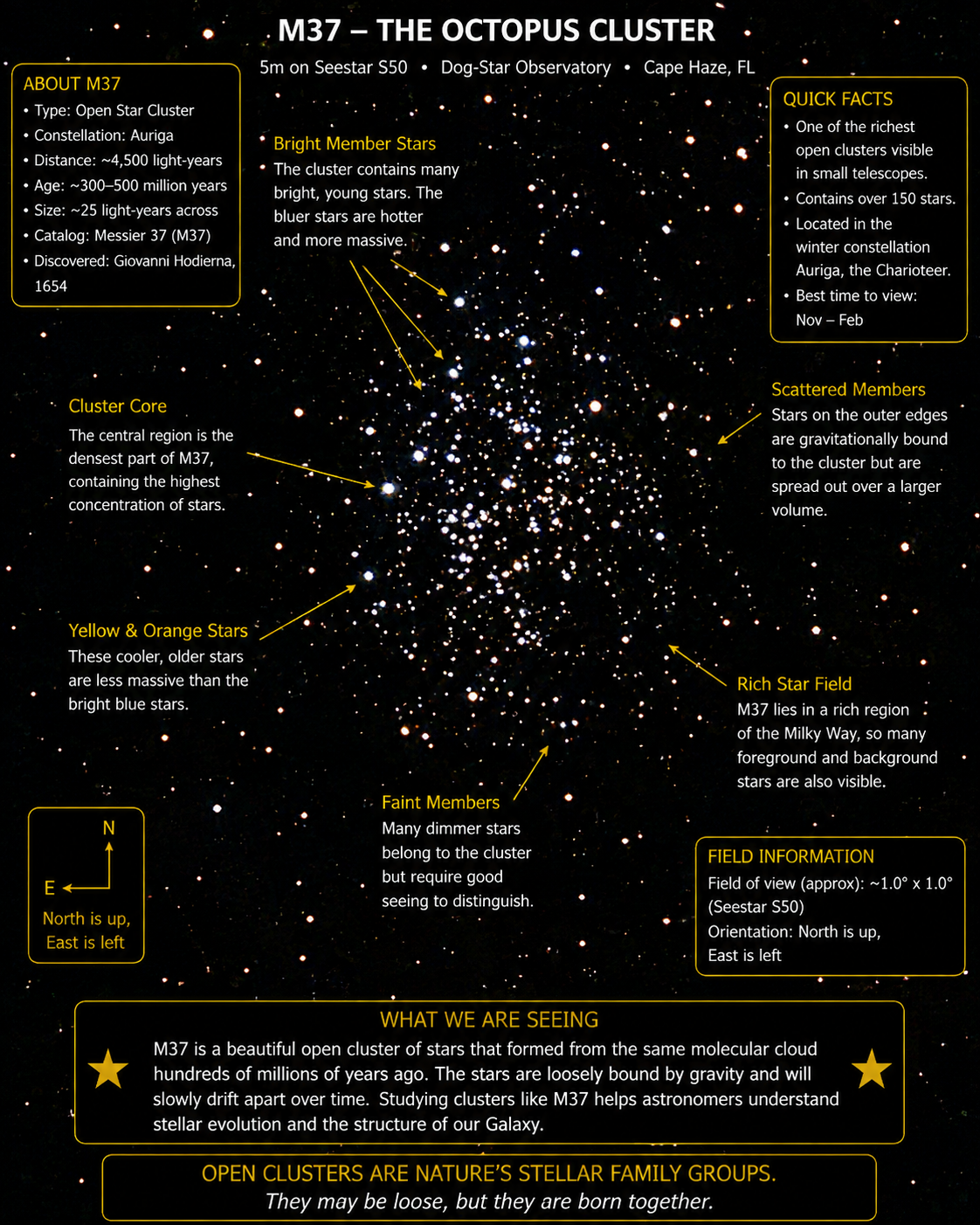
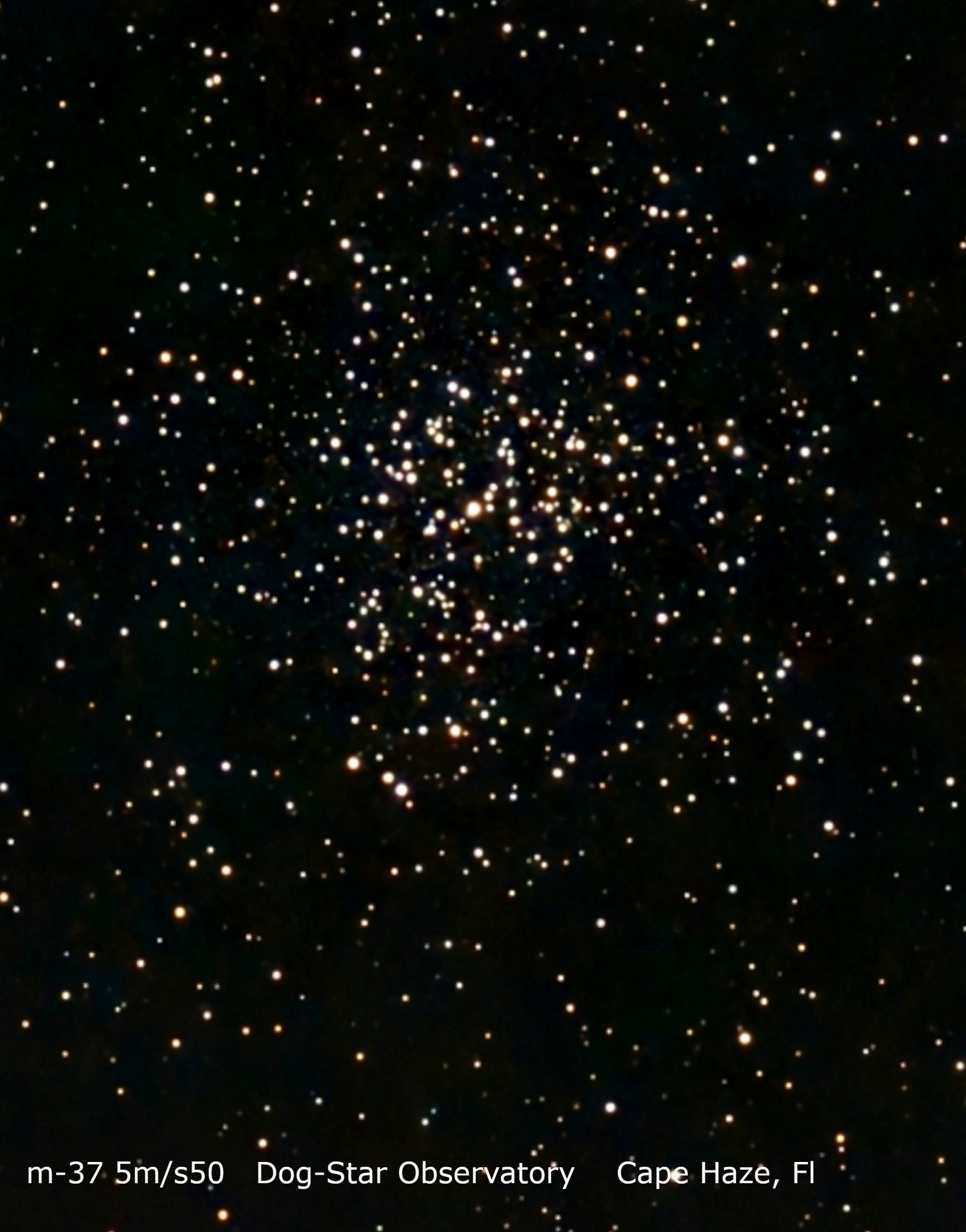
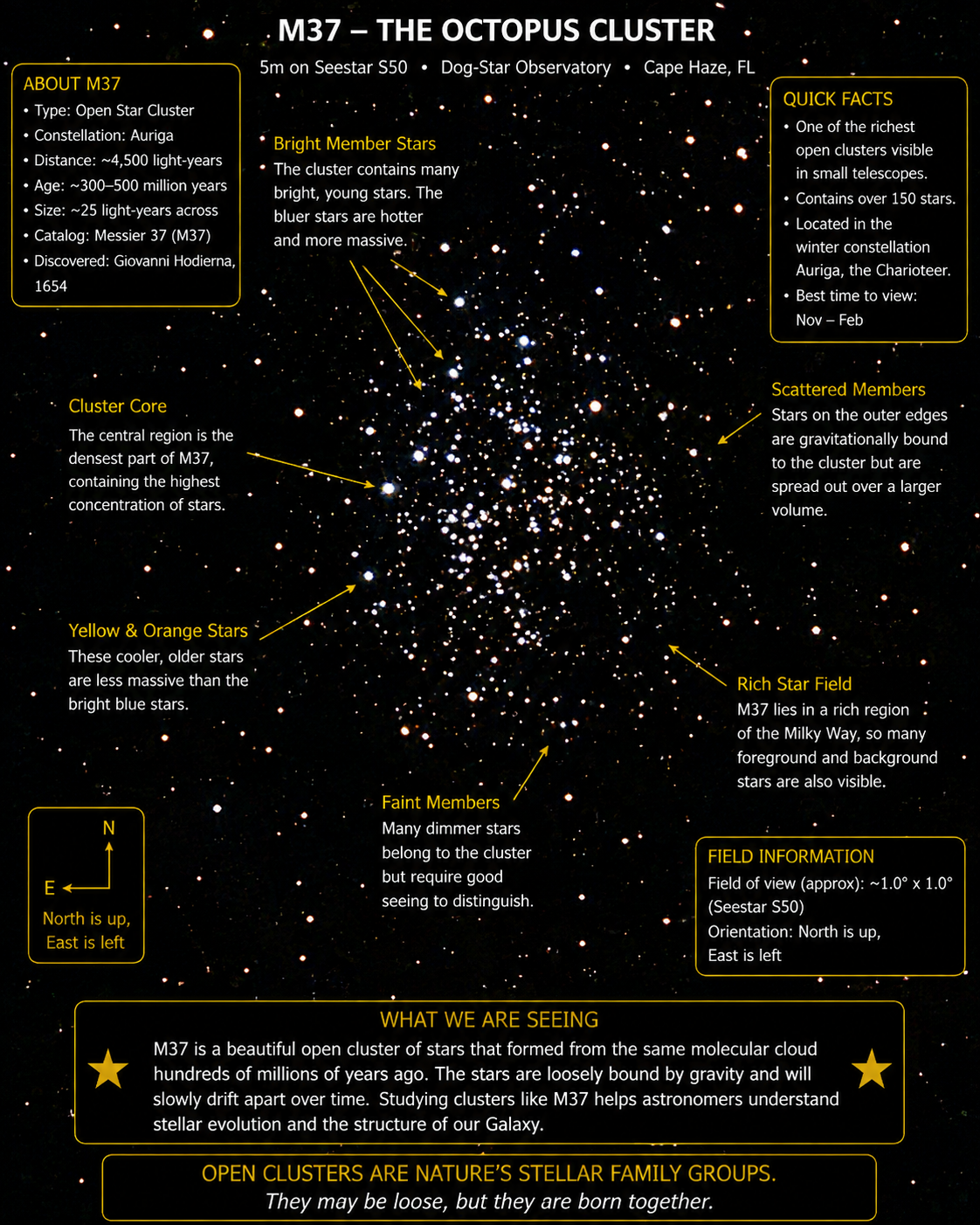
Messier 37 is the richest and most densely populated of the three Messier open clusters in Auriga. It lies about 4,500 light-years away and contains several hundred stars spread across a region roughly 20–25 light-years wide. With an age of several hundred million years, M37 is much older than M36. Many of its most massive original stars have already evolved away from the main sequence, while numerous lower-mass stars remain. The mixture of blue-white, yellow, and orange stars gives the cluster a particularly rich appearance in photographs.
M37 is a valuable laboratory for stellar evolution because its members formed together and therefore provide a population of stars with nearly the same age and distance. Astronomers can compare their colors and luminosities on a color–magnitude diagram to determine the cluster's age and examine how stars of different masses evolve. The presence of evolved red and orange giant stars alongside less massive main-sequence stars illustrates an important principle: the more massive a star is, the more rapidly it consumes its nuclear fuel and leaves the main sequence.
Messier 36 is a young open cluster in Auriga, roughly 4,000 light-years from Earth. It contains many hot, blue-white stars that formed from the same molecular cloud only a few tens of millions of years ago. Because the cluster is relatively young, several of its brightest members are still massive main-sequence stars, and the overall population has not yet had time to disperse far into the Galactic disk.
Open clusters such as M36 are valuable laboratories for stellar evolution because their members share approximately the same age, distance, and original chemical composition. Differences in luminosity and color therefore largely reflect differences in stellar mass. Over time, internal gravitational encounters and the tidal field of the Milky Way will gradually scatter M36's stars into the surrounding disk.
Messier 37 is the richest of the three Messier open clusters in Auriga and lies roughly 4,500 light-years away. It contains several hundred stars and is considerably older than M36, with an age of several hundred million years. That greater age is reflected in its stellar population, which includes evolved yellow and red giant stars in addition to lower-mass main-sequence members.
M37 is especially useful for studying how stars evolve after leaving the main sequence. When its members are plotted on a color–magnitude diagram, the location of the main-sequence turnoff provides an estimate of the cluster's age. The mixture of unevolved and evolved stars makes M37 a compact illustration of the dependence of stellar lifetime on mass.
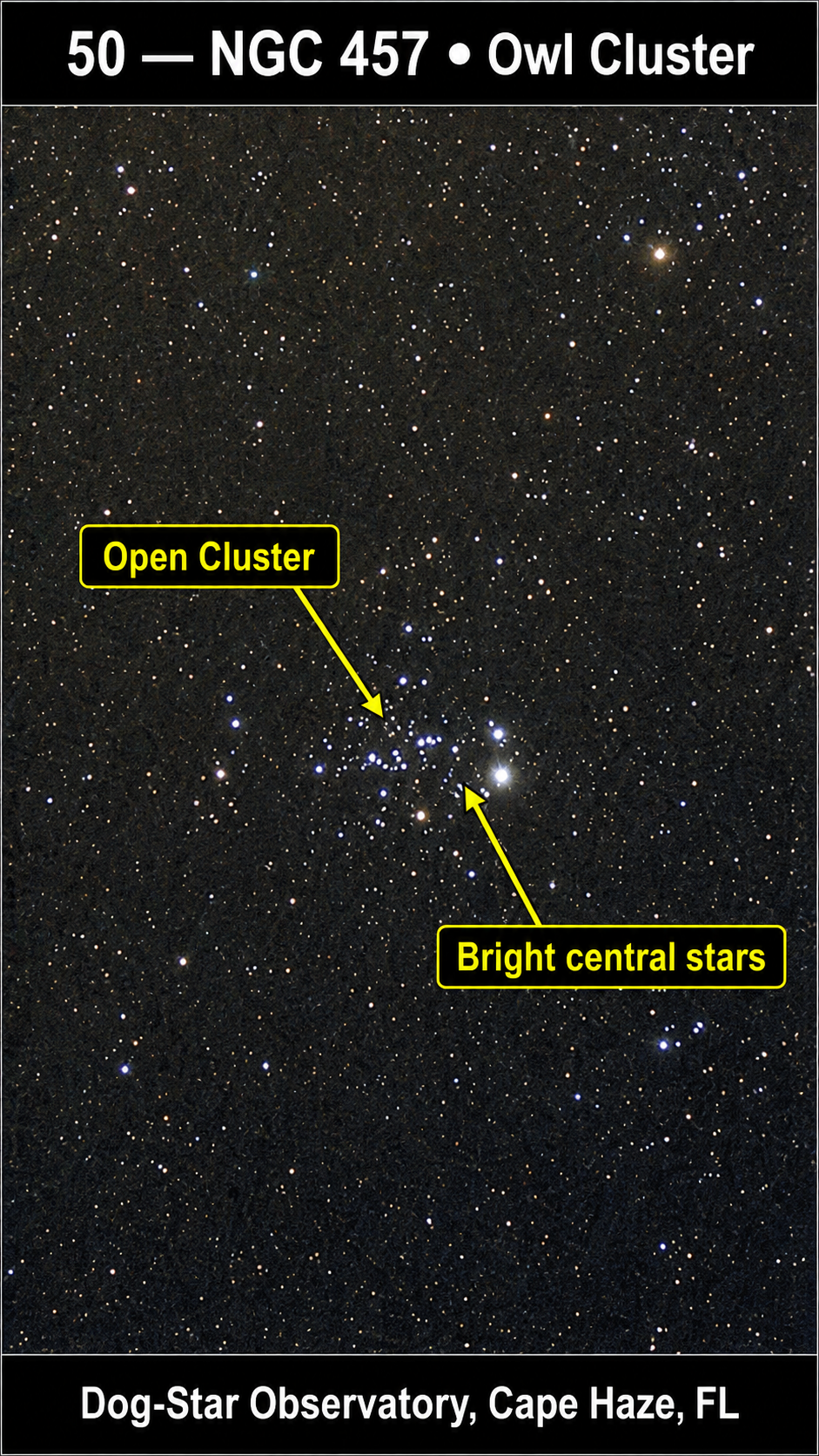
NGC 457 is a young open cluster in Cassiopeia, commonly called the Owl Cluster, E.T. Cluster, or Dragonfly Cluster because its brighter stars form a recognizable figure with two prominent “eyes” and extended chains of stars. The cluster lies several thousand light-years from Earth and contains a relatively young population dominated by hot, luminous stars.
The owl-like appearance is only a line-of-sight pattern, not a literal three-dimensional structure. This makes NGC 457 a useful example of the difference between visual asterisms and true physical membership. Astronomers use proper motion, parallax, radial velocity, and spectroscopy to distinguish genuine cluster members from unrelated foreground and background stars.
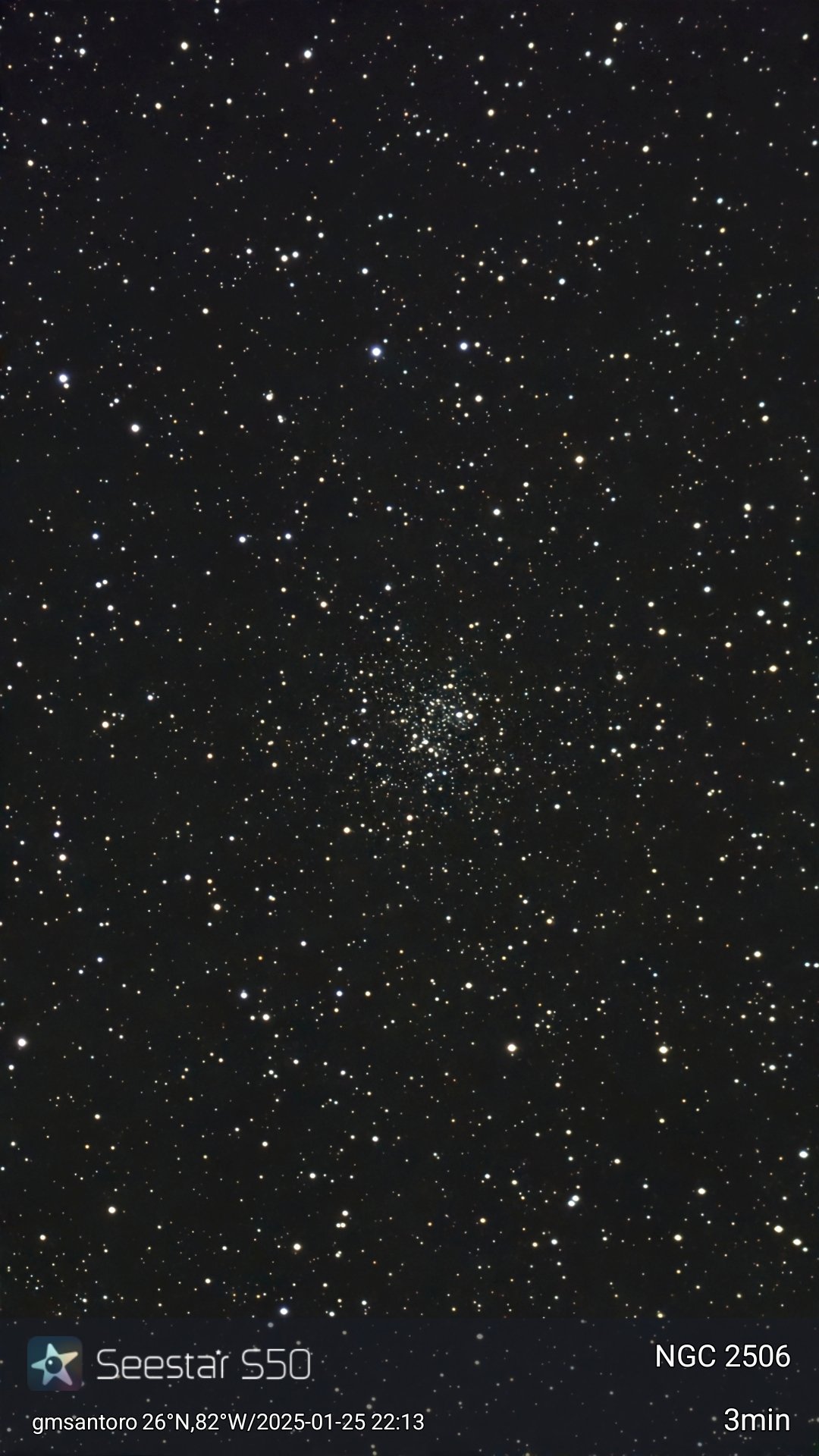
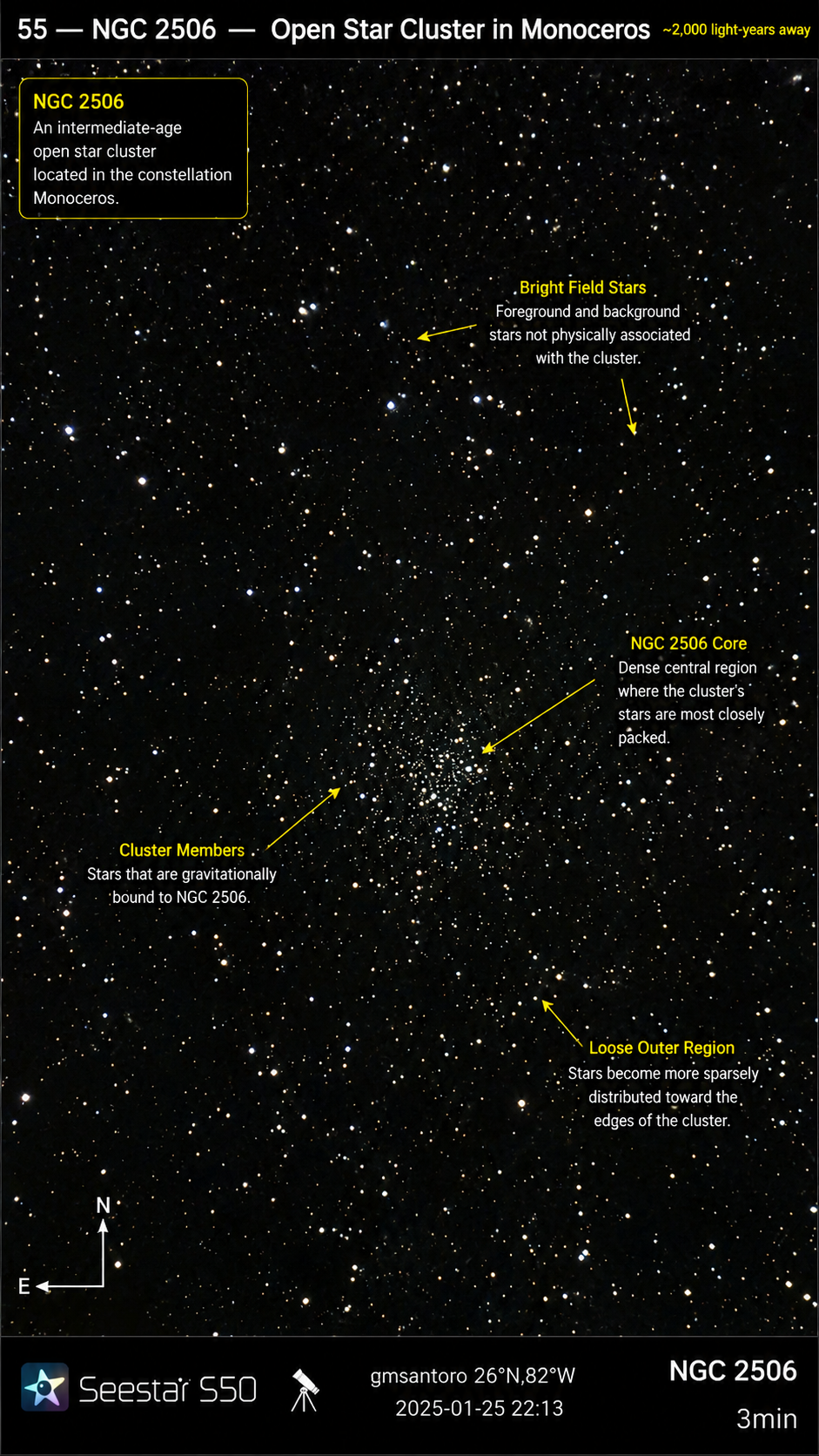
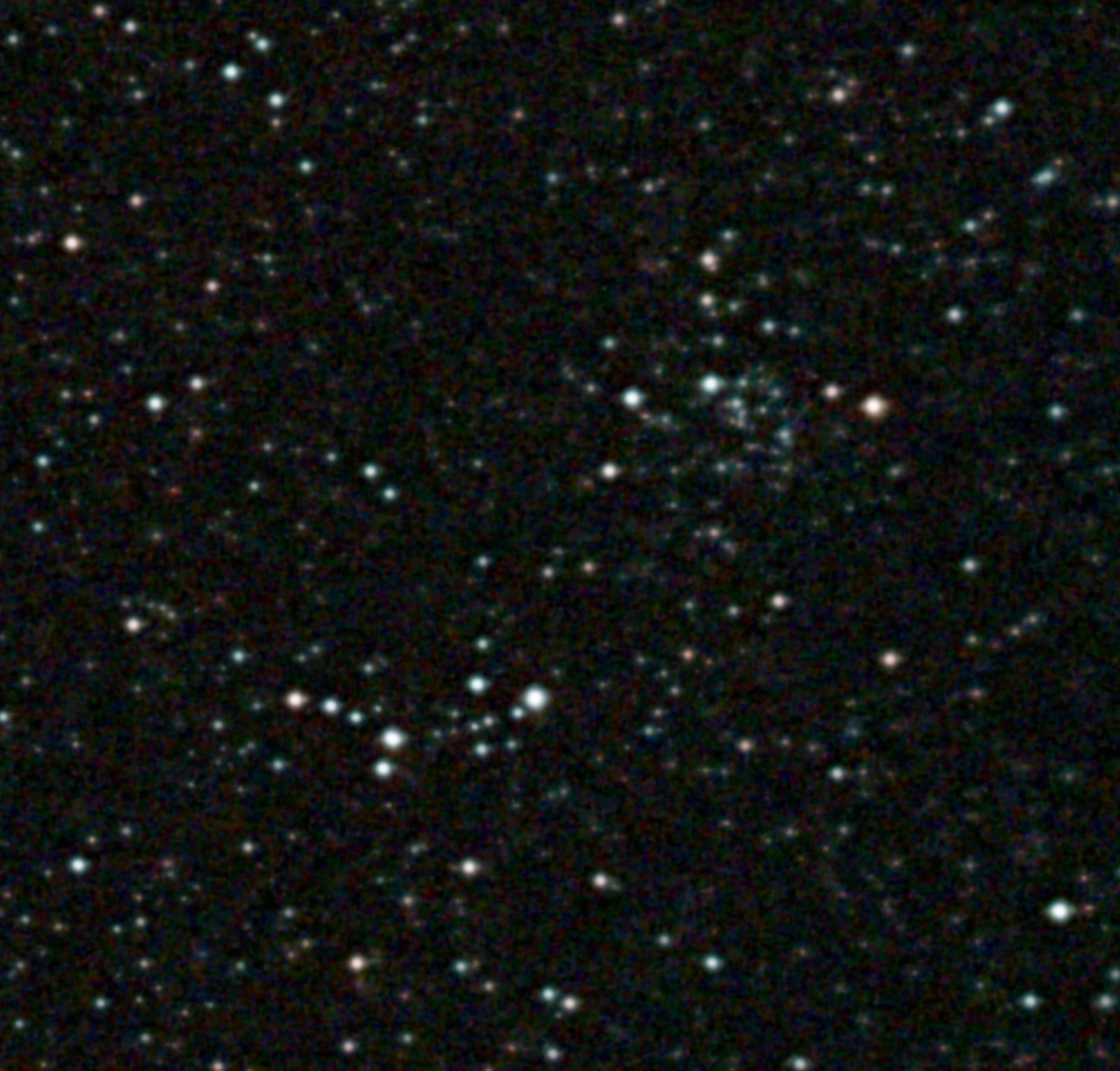
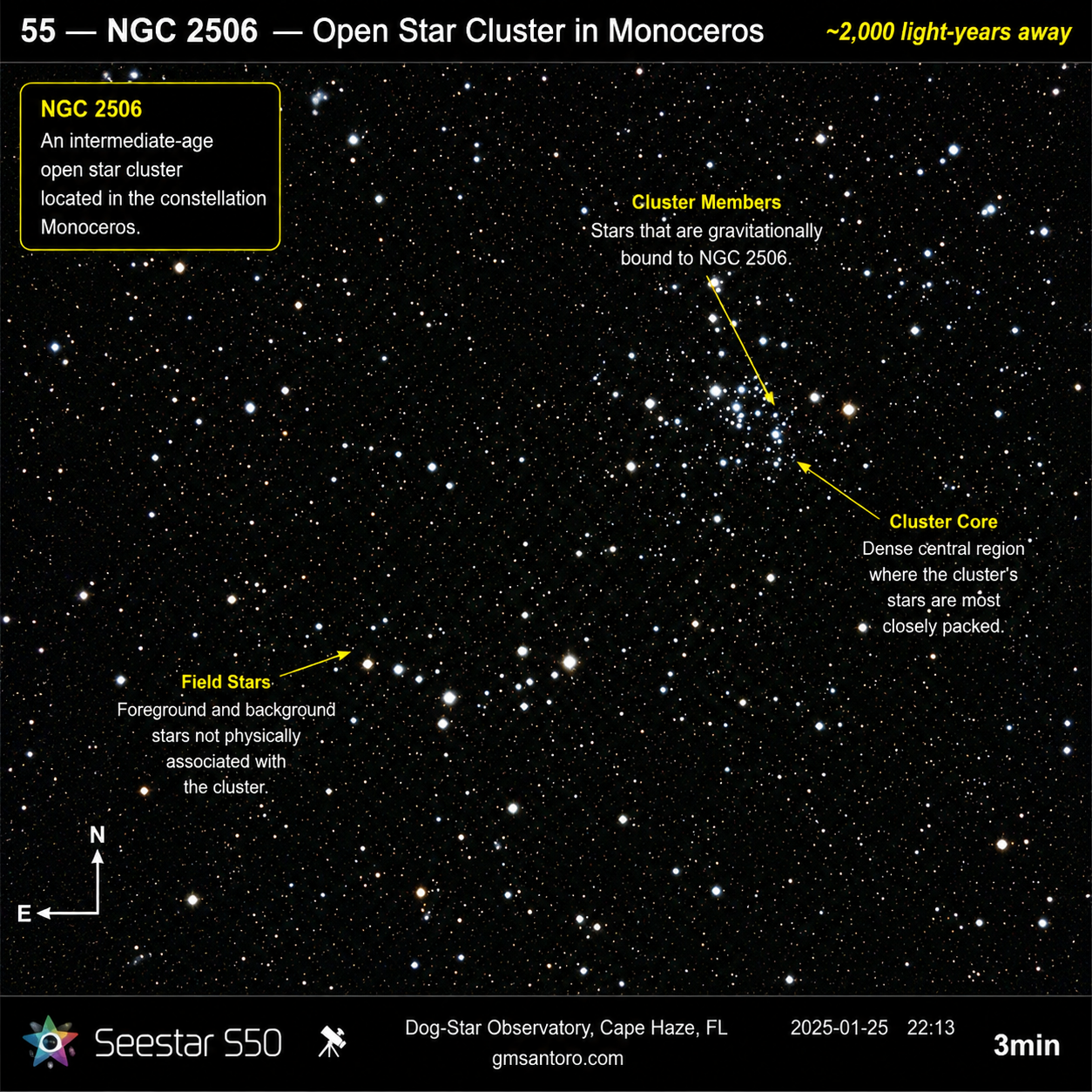
NGC 2506 is a rich open cluster in Monoceros, located roughly 11,000–13,000 light-years from Earth. It is unusually old for an open cluster, with an age approaching two billion years. Most open clusters are gradually disrupted by internal stellar encounters and the tidal field of the Milky Way, so NGC 2506 represents a comparatively long-lived survivor.
Its well-defined main-sequence turnoff and evolved giant stars make NGC 2506 especially useful for testing models of stellar evolution. The cluster is also somewhat metal-poor compared with many nearby open clusters, which makes it valuable for studying how stellar evolution depends on chemical composition and for tracing the history of the Galactic disk.
NGC 2383 is an open star cluster in Canis Major, located roughly 10,000 light-years from Earth. Its stars formed from the same molecular cloud and therefore share a broadly common age, distance, and original chemical composition. The cluster lies in a crowded region of the Milky Way, so many unrelated foreground and background stars appear in the same field, making the true cluster boundaries less obvious than in more isolated open clusters.
NGC 2383 is especially interesting because it lies very close on the sky to the neighboring open cluster NGC 2384. The pair provides a useful example of how apparent proximity does not automatically imply that two stellar groups are physically related. Astronomers compare distances, proper motions, radial velocities, and stellar ages to determine whether nearby clusters share a common origin or are simply projected near one another from our viewpoint.
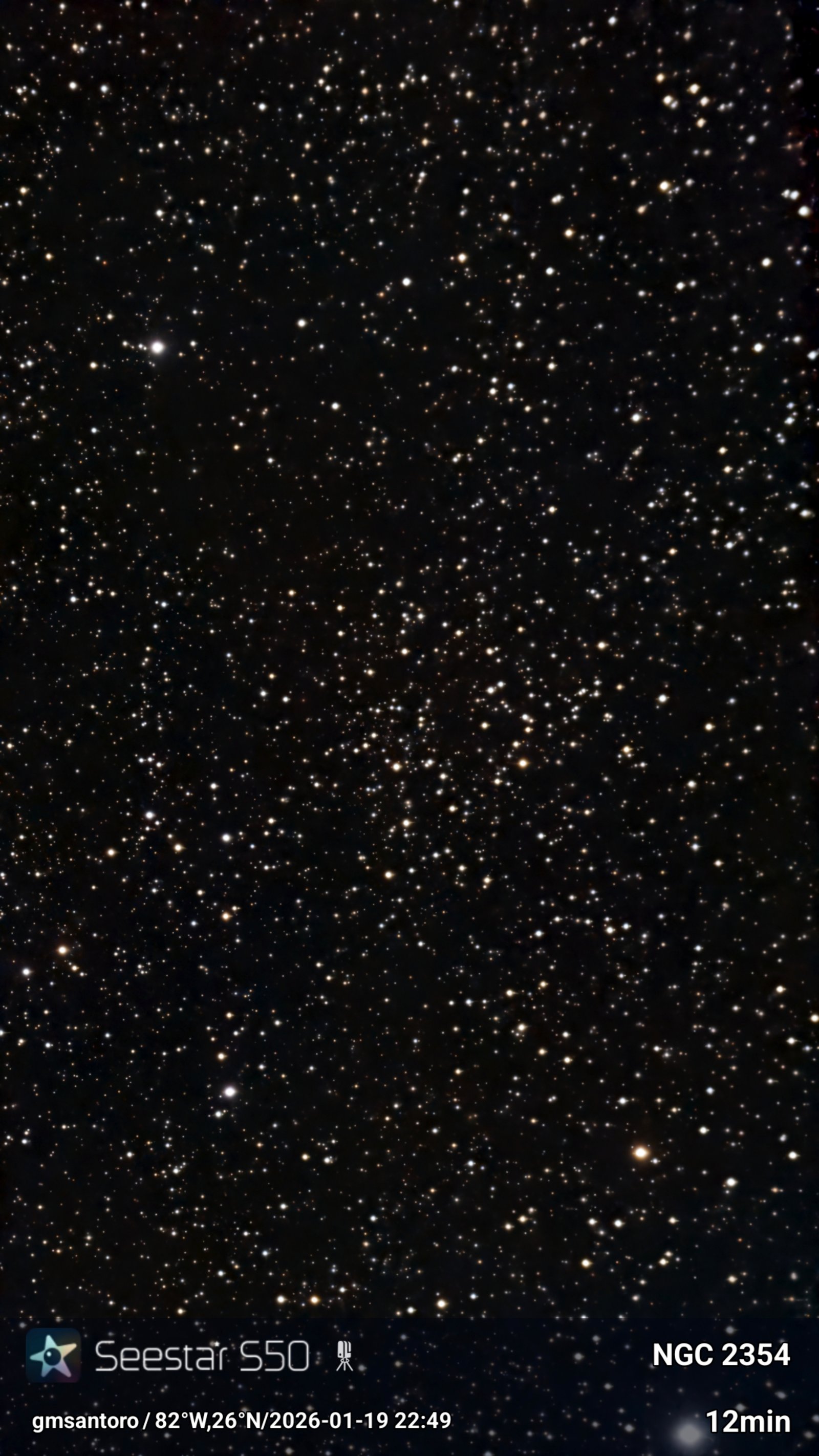
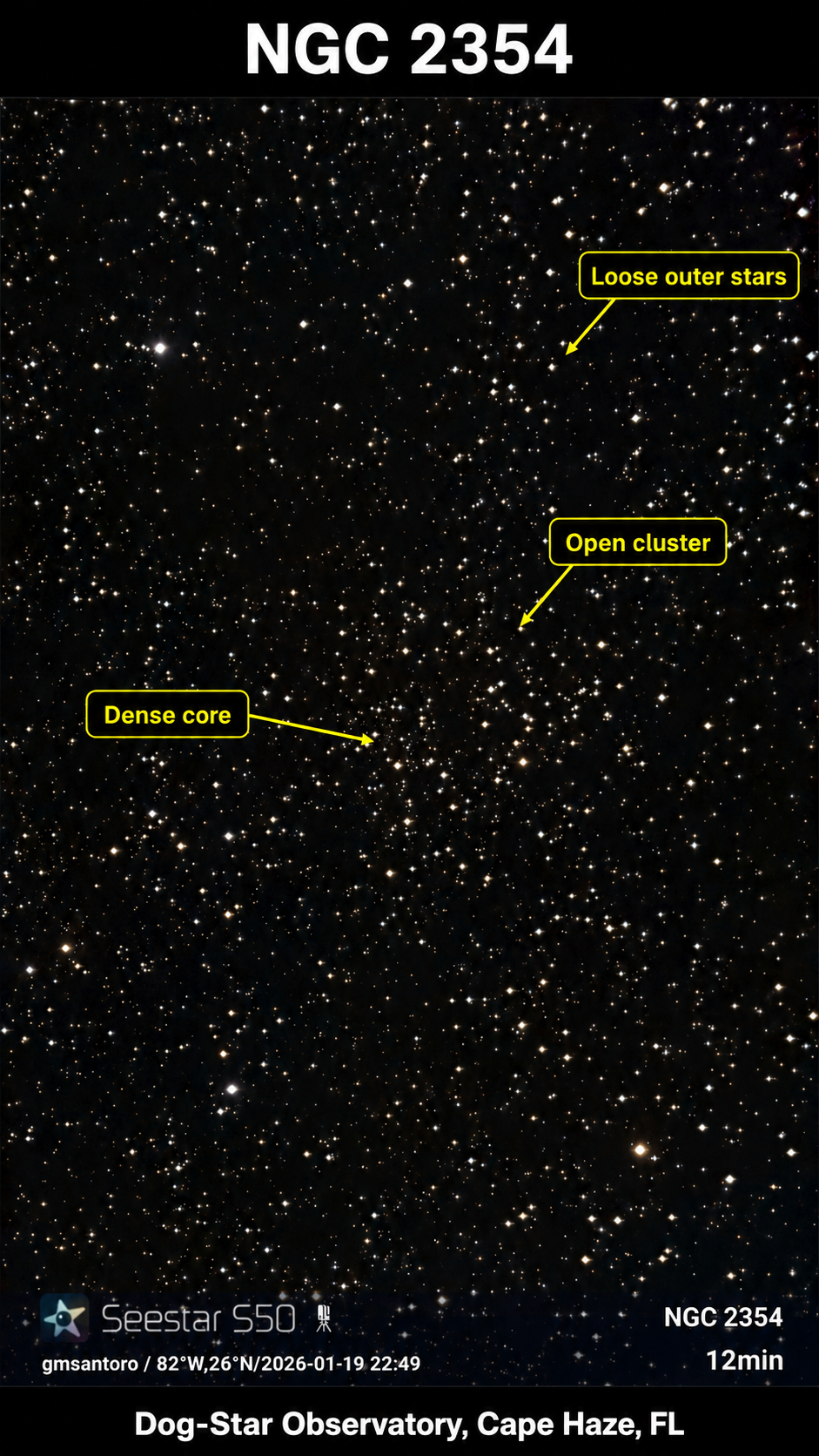
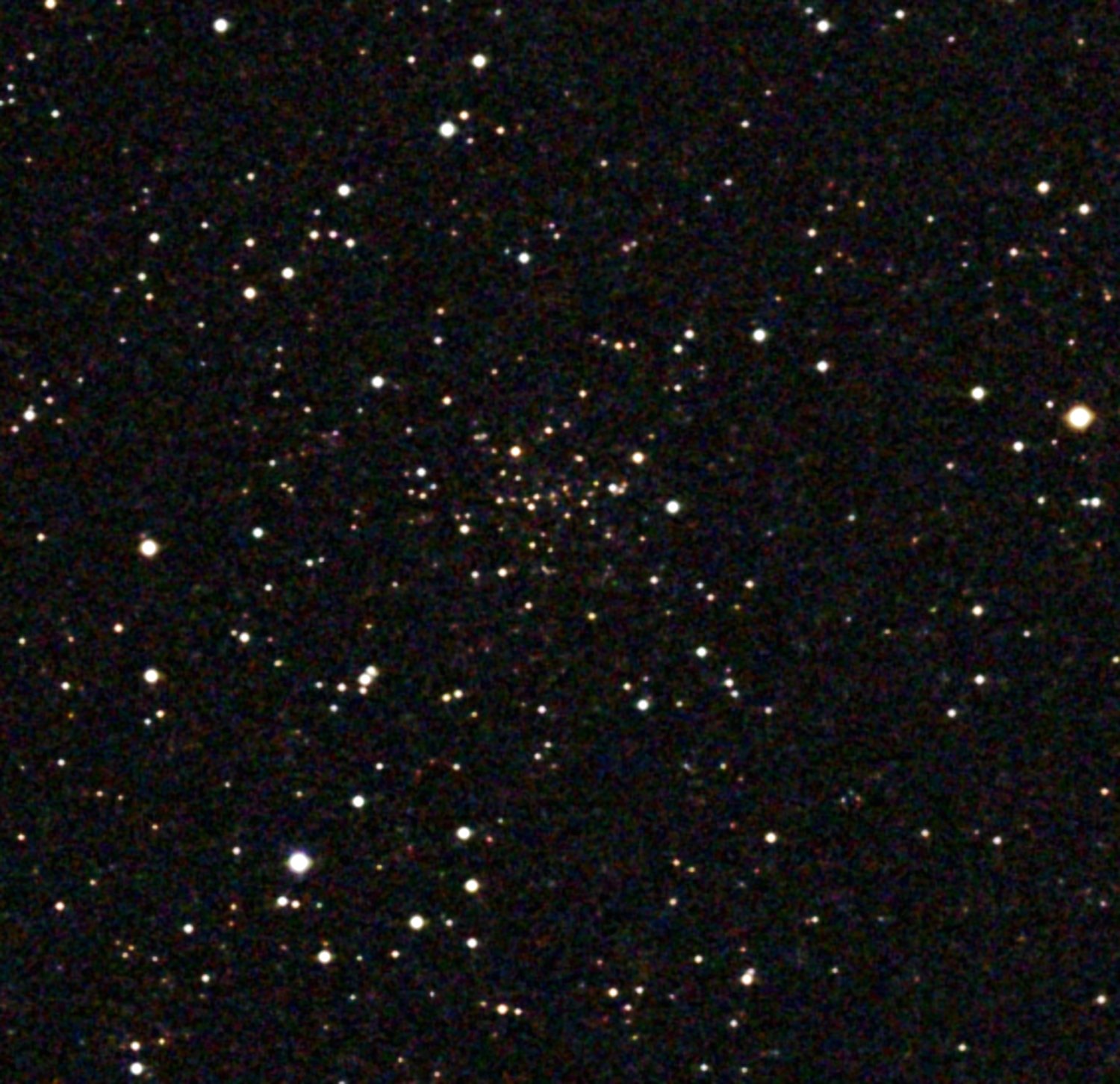
NGC 2354 is an open cluster in Canis Major containing a relatively loose concentration of stars projected against the rich background of the Milky Way. Because it lies close to the Galactic plane, its field includes many foreground and background stars, making cluster membership less obvious than in isolated systems.
Astronomers determine true membership by comparing stellar proper motions, parallaxes, and radial velocities. Once genuine members are isolated, the cluster's color–magnitude diagram can be used to estimate its age and evolutionary state. NGC 2354 is therefore a good example of the observational challenge of separating a real stellar family from a crowded Galactic background.
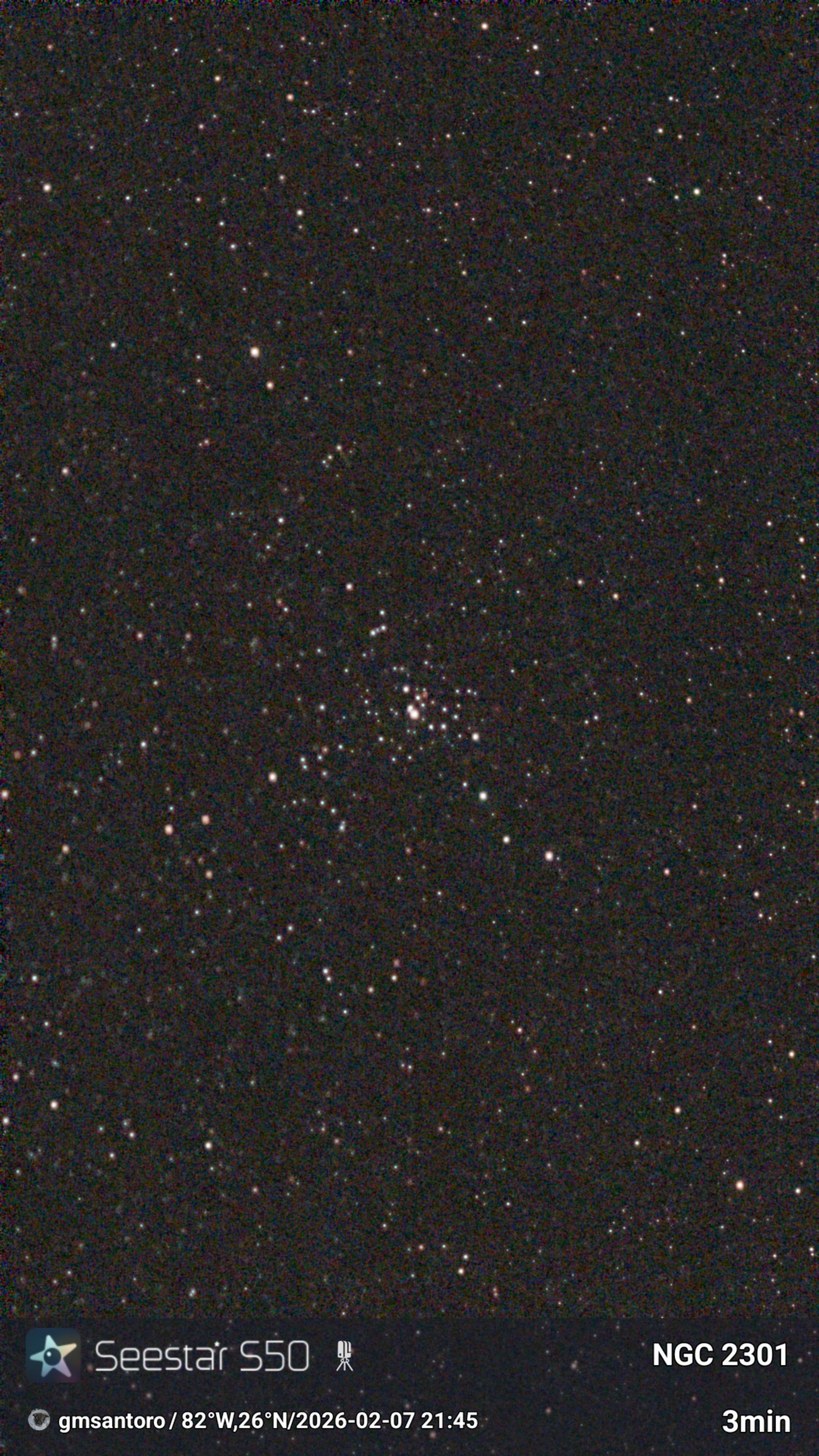
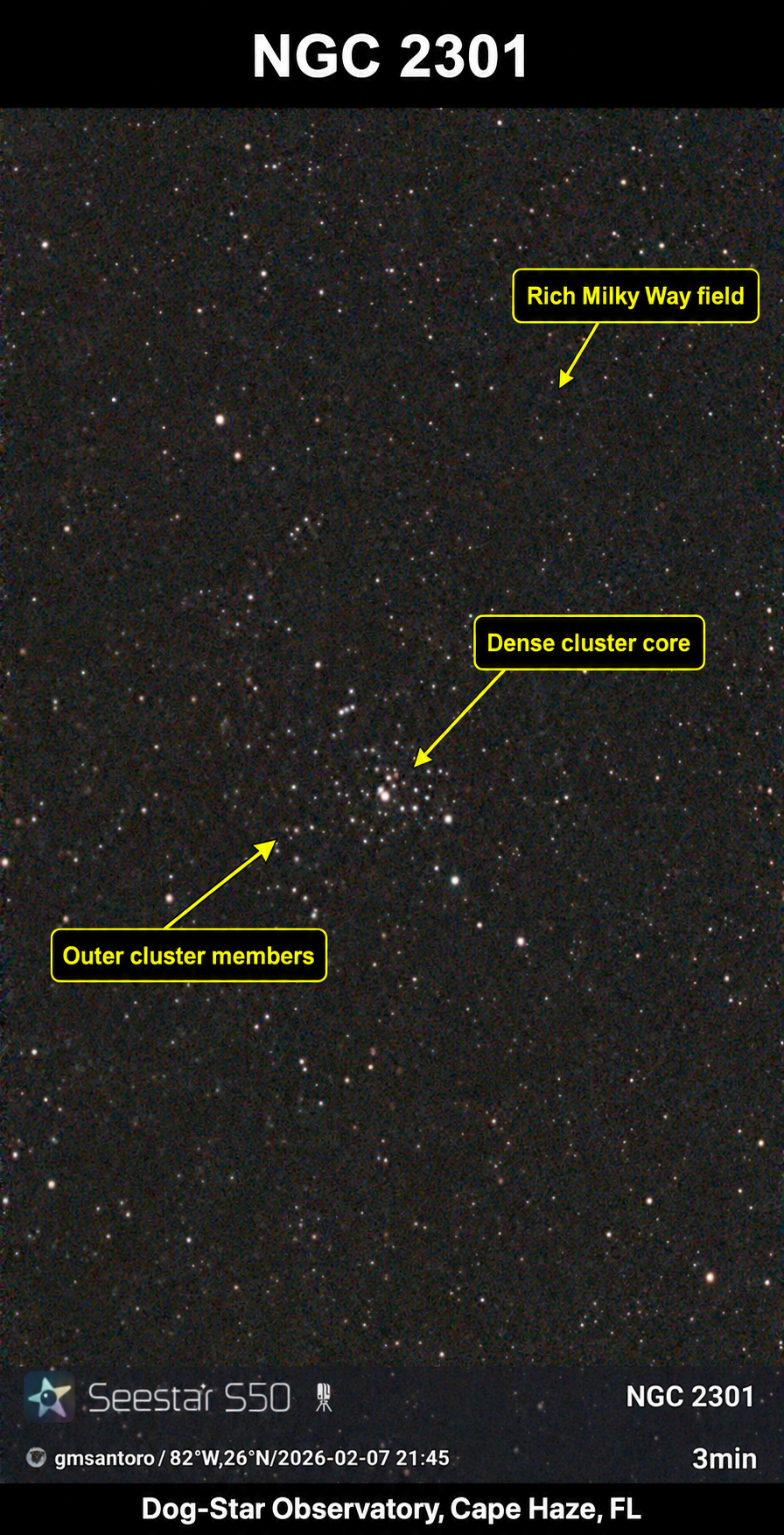
NGC 2301 is a bright open cluster in Monoceros, roughly 2,800 light-years from Earth. It contains a well-defined concentration of stars spread across a broad field and is sometimes informally called the Great Bird Cluster because chains of brighter stars can suggest a birdlike outline in wide-field views.
The cluster is intermediate in age compared with very young systems such as M36 and much older clusters such as NGC 2506. Its stars formed together and therefore provide a population with nearly common age, distance, and initial composition. That makes NGC 2301 useful for testing stellar-evolution models and for studying how open clusters gradually lose members as they orbit through the Galactic disk.
NGC 1798 is an open cluster in Auriga containing a population of stars that formed together from the same interstellar cloud. Like other open clusters, it is gravitationally bound only loosely, so its stars are gradually dispersed by internal encounters and by the tidal influence of the Milky Way.
Older open clusters are particularly valuable because relatively few survive for long periods in the Galactic disk. Their color–magnitude diagrams reveal how the most massive members have evolved off the main sequence, while lower-mass stars remain comparatively unevolved. NGC 1798 therefore contributes to studies of stellar evolution as well as the long-term survival and disruption of open clusters.
Messier 46 is a rich open cluster in Puppis containing hundreds of stars spread across a broad region of sky. Its members formed together and therefore share approximately the same age and distance, making the cluster useful for studying how stars of different masses evolve within a common population.
M46 is especially famous because the planetary nebula NGC 2438 appears superimposed on the cluster. The two objects are not physically associated; the nebula lies in the foreground. This chance alignment provides an excellent reminder that apparent proximity on the sky does not necessarily imply a true three-dimensional relationship.
Copyright G.M. Santoro, PhD, 2026 | contact-gmsantoro@gmail.com